
Psychology
Why Your Win Rate Is Lying to You (And What to Track Instead)
Ask most traders how they're doing, and they'll tell you their win rate. 70% win rate. 65%. "I'm winning most of my trades." It's the number that feels the most like proof.
It's also one of the least useful numbers in trading.
A trader with an 80% win rate can still go broke
Here's the setup that catches people: risking 3x your take-profit on every stop loss. Win 8 out of 10 trades, lose 2 - and if each loss wipes out four wins, that "80% win rate" trader is net negative for the month.
Win rate tells you how often you were right. It says nothing about how much it cost you when you were wrong.
What actually predicts consistency
The traders who last aren't the ones who win the most trades. They're the ones whose process is repeatable - same risk per trade, same rules followed regardless of a winning or losing streak, same stop-loss discipline whether the last five trades worked out or not.
That's the uncomfortable part: process and outcome are two different things, and a good process can still lose money in the short run, while a bad process can still win by accident. If you only track outcome (P&L, win rate), you can't tell the difference between a trader who got lucky and a trader who's actually good.
Two numbers worth tracking instead
Risk:Reward ratio - not just "did I win," but "when I won, how much did I make relative to what I risked when I lost." A trader with a 40% win rate and a 3:1 risk:reward is often in much better shape than an 80% win rate trader risking 3x their reward.
Process adherence - did you actually use a stop loss? Did you follow your own entry checklist? Did you stay within your daily trade limit instead of revenge-trading after a loss? These are things you can control completely, on every single trade, regardless of whether the market cooperates.
Outcome is partly luck. Process is entirely yours.
Seeing both at once
This is the actual gap in most trading journals - they'll show you P&L and win rate beautifully, and completely ignore whether your process was sound. You can have a great month and a terrible process, or a rough month and a genuinely disciplined one, and a journal that only tracks outcome can't tell you which one you're looking at.
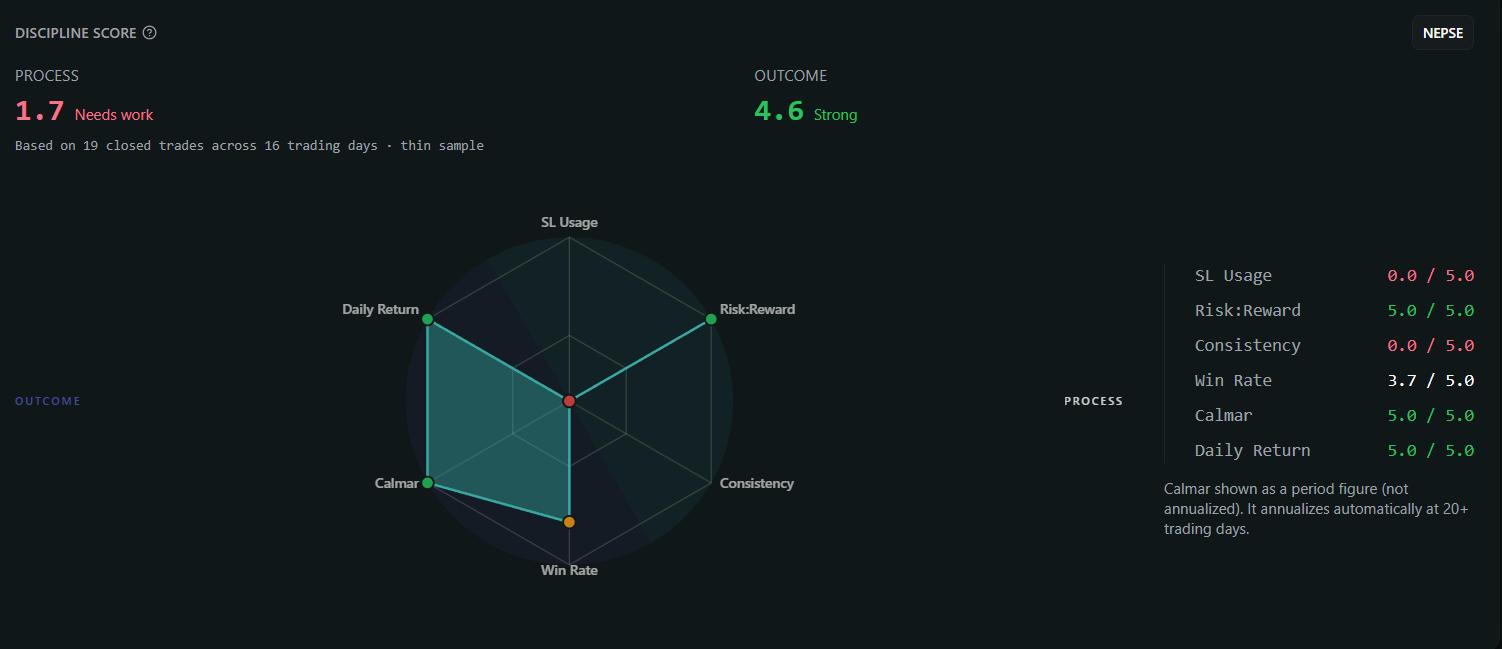
CandleTrace's Telemetry page scores these separately - Process (stop-loss usage, consistency, risk:reward discipline) and Outcome (win rate, Calmar, daily return) side by side, so a strong outcome built on a weak process shows up clearly instead of hiding behind a good month.
The real question to ask yourself
Not "what's my win rate this month" - but "if I ran this exact process for another 100 trades, would I trust the result?"
If the honest answer is no, the fix usually isn't a better setup or a better indicator. It's tightening the process until you'd trust it regardless of how any single trade turns out.
Start journaling NEPSE trades
Create a free account, or explore the live demo with sample data. No signup required.